News

Three goose products with Protected Geographical Indication (PGI) status: Goose, Goose Confit, and Goose Foie Gras from the Southwest

The designations “Oie du Sud-Ouest,” “Confit d’oie du Sud-Ouest ,” and “Southwest Goose Foie Gras” are now officially recognized as Protected Geographical Indications (PGI), following the publication of the implementing regulation in the Official Journal of the European Union on June 11, 2026.

Temps de lecture : 5 min

This official recognition of the three iconic specialties of the Southwest celebrates the historic expertise deeply rooted in the region, as well as an industry structure based on the processing, transformation, and full utilization of the animal.

"Southwest Goose"

The “Southwest Goose” is a goose that is force-fed for the production of meat, confit, and foie gras. It originates from a breeding tradition historically rooted in the Southwest, where corn cultivation and mild climatic conditions have fostered the development of these practices.

As early as the Middle Ages, goose farming was a local specialty, reinforced in the 17th century by the introduction of corn, which shaped the techniques of force-feeding. The region gradually became the cradle of the “foie gras markets,” which contribute to the region’s gastronomic identity.

All stages of production take place within the defined geographical area, which covers a large part of the Southwest.

View the specifications on the product page

oie du sud ouest
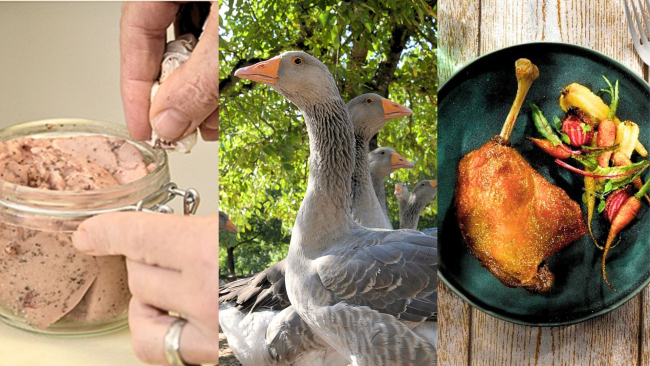
IGP "Oie du Sud-Ouest" © Studio Prigent
confit d'oie
IGP "Confit d'oie du Sud-Ouest" © Studio Prigent

“Goose Confit from the Southwest”

“Confit d’oie du Sud-Ouest” is made from the wings and/or thighs of “Oie du Sud-Ouest” geese, which are salted and then slowly cooked in their own fat.

This expertise, developed as early as the 17th century on farms in the Southwest, is based on a traditional method of preservation using fat. Historically, confit was used to preserve meat and make the most of the entire harvest.

With the rise of preservation techniques in the 19th century, confit spread beyond its region of origin, while retaining its traditional production methods.

View the specifications on the product page

"Goose Foie Gras from the Southwest"

“Southwest Goose Foie Gras” is made from raw livers sourced exclusively from the “Southwest Goose.”

It is distinguished by the quality of the selected livers, which meet specific criteria for weight and suitability for processing. It is sold in various forms: whole foie gras, foie gras, and foie gras blocks, with or without chunks.

Its reputation was built on the development of the foie gras markets, followed by the growth of distribution channels in the 20th century, helping to shape an agri-food sector strongly associated with the Southwest.

View the specifications on the product page

foie gras
IGP "Foie gras d'oie du Sud-Ouest" © Studio Prigent

An industry deeply rooted in its region

“Oie du Sud-Ouest” products, “Confit d’oie du Sud-Ouest,” and “Foie gras d’oie du Sud-Ouest” are produced in a geographic area covering a large part of southwestern France, including notably the departments of Corrèze, Dordogne, Gironde, Landes, Lot-et-Garonne, Gers, and Pyrénées-Atlantiques, as well as several neighboring departments.

Every stage—from raising the geese to processing and packaging—is carried out within this area, ensuring a close link between the products and their origin.

tournesols
Tournesols © Studio Prigent

The designations may be supplemented by geographical references such as “Gers,” “Landes,” “Périgord,” or “Quercy,” which reflect the diversity of local identities within the sector.

These new designations reflect the transmission of traditional know-how and the development of comprehensive supply chains, highlighting each stage of production and the connection between the product and its region.

About Protected Geographical Indication (PGI)

IGP logo

The IGP is linked to a specific know-how. It identifies an agricultural product—whether raw or processed—whose quality, reputation, or other characteristics are linked to its geographic origin. At least one stage of the product’s production, processing, or preparation must take place within the defined geographic area. The IGP guarantees the product protection at both the national and European levels. Compliance with the IGP specifications is regularly monitored by independent, accredited bodies supervised by the government.
Learn more about the PGI

The latest SIQO certifications for French products